|
|
|

Logic and cognitive systems
 Back Back
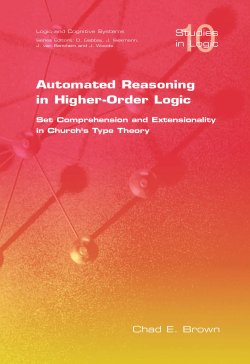 | Automated Reasoning in Higher-Order Logic
Set Comprehension and Extensionality in Church's Type Theory
Chad E. Brown
Many mathematical and computational concepts can be represented in a natural way using higher-order logic. Consequently, higher-order logic has become an important topic of research. Automated Reasoning in Higher-Order Logic presents both a theoretical analysis of fragments of higher-order logic as well as a complete automated search procedure for an extensional form of higher-order logic.
The first part of the book provides a detailed presentation of the theory (syntax and semantics) of fragments of higher-order logic. The fragments differ in the amount of extensionality and set comprehension principles included. Three families of sequent calculi are defined and proven sound and complete with respect to appropriate model classes. Using the model constructions in the book, different versions of Cantor's theorem are determined to not be provable in certain fragments. In fact, some versions of Cantor's theorem are independent of other versions (in sufficiently weak fragments).
In the second part of the book, an automated proof procedure for extensional type theory is described. Proving completeness of such a higher-order search procedure is a nontrivial task. The book provides such a completeness proof by first proving completeness of the ground case and then proving appropriate lifting results.
Automated Reasoning in Higher-Order Logic is an essential document for researchers in higher-order logic and higher-order theorem proving. The book is also essential reading for programmers implementing or extending higher-order search procedures.
Users of higher-order theorem provers can use the book to improve their understanding of the underlying logical systems.
978-1-904987-57-4
Buy from Amazon: UK US
|
|
|